
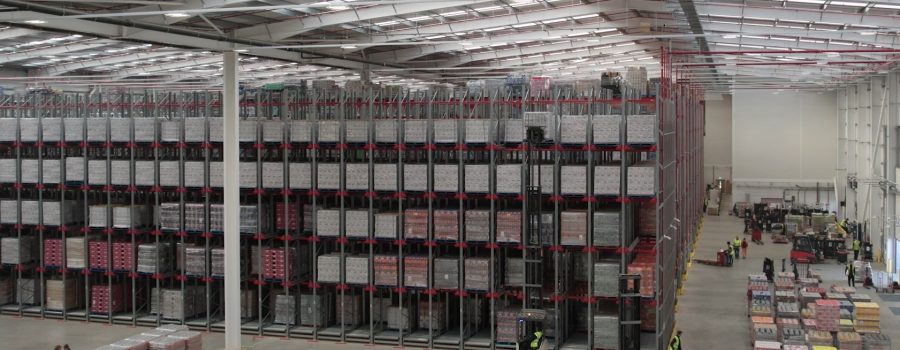
When companies approach us, it is rarely because they simply want ‘new racking’ or ‘warehouse automation’.
They usually come to us because their warehouse is under pressure.
Space is tighter. Volumes are growing. Service levels are rising. Labour is harder to secure. Costs are making them uncompetitive.
In practice, those challenges tend to fall into one or more of three categories.
- Store the same capacity in less space
- Create more capacity within the same footprint
- Increase throughput without increasing complexity
Sometimes it is just one of these. More often than not, it is a combination.
Our role is to understand which challenge matters most today, which are coming next and how to design a solution that genuinely improves the operation – rather than moving the problem elsewhere.
1. Store the Same Capacity in Less Space
This challenge usually appears when a business is being squeezed by rising costs.
Rent, land, rates, energy, and labour all push operators to make better use of the space they already have. Expanding the building is expensive. Moving site is disruptive.
In these cases, the objective is not to store more product. It is to store the same volume more efficiently.
How we solve it:
The starting point is layout and density. Traditional pallet racking is flexible, but it is not space-efficient.
Aisles take up a significant percentage of the warehouse footprint.
By introducing high-density storage principles, we can often recover a substantial amount of space including:
- Narrower aisles using guided or VNA equipment
- Deep-lane solutions such as push-back or shuttle systems
- Re-engineering beam levels and clearances to remove wasted air
- Using picking towers to store low volume SKUs
Where automation and semi-automation help
Semi-automated systems such as pallet shuttles reduce the need for multiple access aisles while maintaining control and selectivity.
Automated solutions like AutoCube® go further – removing aisles almost entirely and allowing the building to be used as a storage volume rather than a series of forklift lanes.
The result is the same stock, stored in less space, with safer and more consistent handling.
2. Creating More Capacity in the Same Space
This challenge is often driven by growth, but can also arise when consolidating multiple storage areas.
Volumes are increasing. SKUs are expanding. Service expectations are rising.
But the building is fixed.
The question is simple: how do we fit more in without compromising access, safety, or efficiency?
How we solve it
The answer usually involves “going higher”. However, increasing capacity through great design requires a combination of:
- Better cube utilisation
- Improved access to every pallet
- A storage strategy aligned with real picking and replenishment patterns
This is where design and a true understanding of warehouse capacity, SKU volumes and throughput become critical.
The optimum design usually combines multiple solutions to achieve the right balance of maximising capacity and delivering throughput. The types of solutions will often depend on the number and complexity of SKUs.
Where automation and semi-automation help
Automated pallet storage systems, such as four-way shuttle solutions, provide full access to every pallet while dramatically increasing density.
Because the shuttle moves in multiple directions and operates within the racking structure, storage layouts are no longer constrained by forklift geometry.
This means:
- Higher storage density
- Full pallet accessibility
- Capacity increases without expanding the footprint
For businesses not yet ready for full automation, hybrid or semi-automated systems can still deliver meaningful capacity gains while allowing a phased transition in the future.
3. Increasing Throughput
Throughput is often the hidden constraint.
Stock may physically fit in the building, but the operation struggles to move it quickly, consistently, or predictably. Peaks become painful. Labour becomes stretched. Errors creep in.
In these cases, the issue is not storage alone.
It is flow.
How we solve it
Improving throughput starts with understanding how product actually moves through the warehouse.
- Where are the bottlenecks?
- Where do people wait?
- Where does congestion occur?
Solutions often involve:
- Separating storage from picking activity
- Reducing travel distances
- Creating predictable, repeatable workflows
Where automation and semi-automation help
Automation excels at consistency.
Automated storage and retrieval systems deliver pallets or totes to fixed interfaces at a predictable rate. Software orchestrates movements to avoid congestion and prioritise the right stock at the right time.
Semi-automated solutions can remove the most inefficient travel while keeping people involved where flexibility is required.
The outcome is higher throughput – without adding more people, more equipment, or more pressure.
One Problem Today. A Different One Tomorrow.
What we see time and again is that capacity, space and throughput challenges are connected.
A business may start by needing more capacity. Then space becomes the constraint. Then throughput becomes the limiting factor.
That is why our focus is not just on solving today’s problem, but on designing warehouse systems that can adapt as the operation evolves.
Sometimes that means automation now. Sometimes it means designing a manual or semi-automated solution that is ready for automation later.
The right answer depends on the operation, the timeline, and the commercial reality.
Our job is to make sure the solution genuinely supports the business, both now and in the years ahead.


