
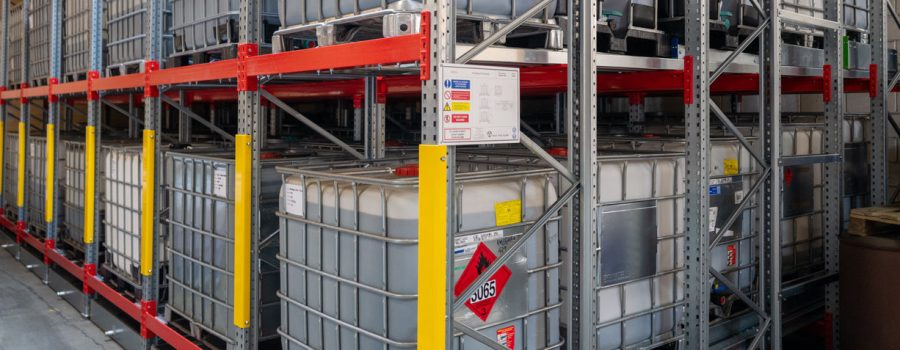
Intermediate bulk containers (IBCs) are one of the most efficient ways to store and transport large volumes of liquid. But the way most businesses store their IBCs is costing them far more than they realise covering floor space, safety risk and regulatory exposure.
This guide covers everything you need to know: the challenges of conventional IBC storage, the racking and automated solutions available, bunding and compliance requirements, and how to choose the right approach for your facility.
What Is an IBC?
An intermediate bulk container (IBC) is a reusable industrial container designed for the storage and transport of bulk liquids, semi-solids, pastes, and solids. Standard IBCs hold 1,000 litres, are cube-shaped with a rigid metal cage around a plastic inner vessel, and are designed to be handled by forklift.
They are widely used across food and drink manufacturing, chemicals, pharmaceuticals, oil and gas, and agriculture, wherever large volumes of liquid need to be stored efficiently.
The Problem With How Most Companies Store IBCs
Despite being cube-shaped (which might suggest they stack neatly and efficiently), IBCs create significant storage challenges when managed in the traditional way.
The Stacking Limit Problem
The Health and Safety Executive (HSE) guidelines state that filled IBCs should be stacked no more than two high, and only where the IBCs have been specifically designed for stacking and ground conditions are suitable.
In practice, many businesses are now reluctant to stack IBCs at all, given the value of the products being stored and the hazardous nature of many IBC contents. That means an enormous amount of floor space is being used at ground level only, with the height of the building left completely wasted.
The Space Cost Is Significant
To put that in concrete terms: a company with 24 IBCs to store would need approximately 28.8 square metres of floor space with no stacking. Stacking to the permitted two high reduces this to 14.4 square metres, but still leaves significant capacity unused.
The Health & Safety Risk
Storing IBCs at ground level without proper racking creates a number of safety issues. Leaks are harder to detect early because IBCs are packed tightly together. Stacked IBCs can sit unevenly due to minor differences in shape and specifications, placing significant pressure on the corner of the IBC below, leading to punctures and structural damage. In a worst case, a failing IBC in a dense storage area can cause a significant health, safety, and environmental incident before anyone has noticed a problem.
The Four IBC Storage Solutions: When to Use Each
There is no single right answer for IBC storage. The best solution depends on the number of IBCs you need to store, your available floor space and building height, the nature of the contents, and your operational requirements. Here is a breakdown of the main options.
1. IBC Pallet Racking
Standard IBC pallet racking uses purpose-built heavy-duty racking with open-boarded timber decks to provide safe forklift-accessible storage at multiple levels.
The impact on space utilisation is transformative. That same 24 IBCs we mentioned earlier (requiring 28.8 square metres of floor space with no stacking) can be stored in a single run of IBC pallet racking in just 7.53 square metres: 6 IBCs wide by 4 high.
Key benefits:
- Up to 4 or 5 IBCs high (subject to weight and forklift specification)
- 100% accessibility to every IBC at all times
- Can incorporate bunded storage and drip trays
- Dramatically reduces floor footprint
2. IBC Push Back Racking
Where density is the priority, IBC push back racking stores IBCs multiple positions deep on gravity-fed carts, meaning each lane can hold several IBCs behind the front-facing position.
Using push back racking, those same 24 IBCs can be stored 4 wide by 2 deep by 4 high in just 11.16 square metres, and the system scales significantly beyond that.
One of our clients in the food and drink sector is now storing 120 IBCs in just 55 square metres thanks to a push back racking solution storing 4 high, 6 wide and 5 deep. Another is storing 140 IBCs in the same floor area using a solution that combines push back racking with integrated bunding.
Push back racking is ideal when:
- You have high volumes of IBCs to store
- Building height is available
- You need a balance of density and accessibility
- Content is consistent across IBCs (fewer SKUs)
3. Bunded IBC Storage
Where IBCs contain hazardous materials, flammable liquids, or chemicals, bunded storage is not just best practice; it is likely a legal requirement.
Under the Pollution Prevention Control Regulations, the physical storage of IBCs containing potentially hazardous materials falls within your regulatory obligations. Your risk assessment, your Waste Management Licence, and your internal environmental policy will together determine whether bunded storage is required.
The standard guideline for bund capacity is 110% of the volume of the largest container, or 25% of the total volume stored, whichever is greater, however this is usually specified by your Health and Safety Manager. Thistle Systems can design and fabricate bunded racking solutions to meet these requirements, including integrated drip trays for upper racking levels that feed by gravity to ground-level bunds
4. Automated IBC Storage
For higher-volume operations where efficiency, stock rotation and reduced manual handling are priorities, automated IBC storage systems remove forklifts from the equation entirely.
Rather than relying on forklift movements to place and retrieve IBCs, automated systems use shuttle and conveyor technology to manage storage and retrieval automatically, improving throughput, reducing labour, and enabling much higher density storage than manual racking can achieve.
Automated IBC storage is particularly relevant for:
- High-throughput operations
- Facilities with significant forklift traffic in hazardous zones
- Operations looking to reduce labour dependency
- Companies with variable IBC volumes and stock rotation requirements
Read our article now about Automated IBC Storage
Case Study
120 IBCs. 55 square metres. Zero compromise on safety.
A major drinks manufacturer was storing IBCs using a combination of ground-level block stacking and basic racking, constrained by safety concerns and rapidly running out of space. Thistle Systems designed and installed a specialist push back racking solution storing IBCs 4 high, 6 wide and 5 deep. The result: 120 IBCs stored in 55 square metres, with full forklift access to every position and complete peace of mind on safety.
FREE IBC STORAGE ASSESSMENT
Not sure which IBC storage solution is right for your facility?
Our specialists will review your current setup, your space constraints, and your operational requirements, so we can show you exactly how much space you could recover and what solution would work best.
Book Your Free IBC Storage Assessment. No obligation. Typical assessment takes less than one hour.
HSE Guidelines for IBC Storage: What You Need to Know
Health and safety requirements for IBC storage cover several areas. This is not a substitute for professional H&S advice, but here is a summary of the key obligations most businesses need to understand.
Stacking: HSE guidance limits filled IBCs to two high under standard conditions. Any stacking above this requires specific engineering justification and appropriate racking.
Risk Assessment: A formal risk assessment is required for any area or building storing combustible liquids in IBCs or plastic drums with flashpoints up to 200°C. This assessment will inform safe storage layout requirements.
Bunding: The Pollution Prevention Control Regulations require adequate containment for any liquid that could cause environmental harm. The 110% / 25% bunding rule applies in most scenarios involving IBC storage of liquids.
Early Detection: Your storage design should enable regular visual inspection of all IBCs to detect leaks early. Overcrowded ground-level storage is one of the most common reasons leaks go undetected until they become a major incident.
IBC Storage by Sector
IBC storage challenges vary by industry. Here is how the core issues and solutions typically apply across the sectors Thistle Systems works with most frequently.
Food & Drink Manufacturing
The most common scenario: high volumes of IBCs storing ingredients or finished products, tight floor space, HACCP and food safety obligations, and a need for full traceability. Push back racking with integrated bunding and the ability to store IBCs and pallets in the same system is the most common solution in this sector.
Chemical & Hazardous Environments
COMAH-regulated sites, DSEAR compliance requirements, and strict environmental obligations make IBC storage in chemical environments significantly more complex. Bunded storage is almost always required. Where hazardous drums are also stored on site, our AutoCube X automated drum storage system may also be relevant to your operation.
Oil & Gas
Large volumes, multiple SKUs, and the need for a high number of picking faces in a limited footprint make adjustable pallet racking the most common IBC solution in this sector. In one oil and gas project, Thistle Systems delivered over 600 pallet positions, after reviewing and ruling out push back and shuttle options based on the specific operational constraints of the site. Read the full case study here>
Frequently Asked Questions IBC STorage
How many IBCs can you stack safely according to HSE guidance? HSE guidelines state that filled IBCs should be stacked no more than two high, and only where the IBCs have been designed for stacking and ground conditions are appropriate. Many businesses choose not to stack at all due to the nature of their products. Specialist racking allows safe storage at 4 to 5 levels high.
Do I need bunded storage for my IBCs? It depends on what your IBCs contain. If you are storing liquids that could cause environmental harm, bunding is likely required under the Pollution Prevention Control Regulations. A risk assessment will confirm requirements. The standard bund capacity requirement is 110% of the largest container volume or 25% of total volume, whichever is greater.
What is the difference between IBC pallet racking and IBC push back racking? Standard IBC pallet racking stores one IBC per position and offers 100% accessibility. Push back racking stores multiple IBCs deep on gravity-fed carts, providing significantly higher density but last-in, first-out (LIFO) access. The right choice depends on your access requirements and the nature of your stock rotation.
Can IBC racking systems be bunded? Yes. Thistle Systems designs and fabricates integrated bund solutions for IBC racking, including drip trays for upper levels that feed by gravity to ground-level containment bunds. This is a standard feature of our Maxi Cube IBC racking range.
What is the smallest footprint possible for IBC storage? This depends on volume and building height, but as a reference point: Thistle Systems has stored 140 IBCs in a floor area of just 55 square metres using a four-level dynamic push back racking solution. Every project is modelled individually to find the optimum configuration.
Are there automated IBC storage solutions available? Yes. For high-volume operations, automated IBC storage systems using shuttle and conveyor technology eliminate forklift dependency and enable significantly higher density and throughput than manual racking. Read more about automated IBC storage →
Case Study
140 IBCs. 55 square metres. Integrated bunding. Zero compromise.
A food and drink company required a high-density IBC storage solution with full HSE compliance and integrated bunding. Thistle Systems designed and installed a dynamic four-level push back racking solution with gravity-fed carts storing up to six IBCs deep per lane, and 1,000-litre galvanised steel drip trays below every lane feeding to a ground-level bund. The system stores 140 IBCs in 55 square metres and meets all SEPA and Pollution Prevention requirements.
Why Thistle Systems for IBC Storage?
Thistle Systems has been designing, supplying and installing specialist IBC storage solutions across the UK for over two decades. Our Max the Cube® approach means we start from your space: your building height, your floor area and your operational constraints. We work backwards to find the configuration that delivers the most storage in the least space, safely and compliantly.
We are SEMA-approved and our installations are carried out by SEIRS-accredited installers. Every IBC storage project includes a full structural design, load calculations, and a project-specific risk assessment.
We do not sell off-the-shelf racking. We design, supply and install highly efficient IBC storage systems to suit your requirements.
Ready to Discuss Your IBC Storage Project?
Whether you are dealing with a space problem, a compliance issue, or simply looking to understand your options, we can help.
Book a Free IBC Storage Assessment or call us on 01236 453888
Related Solutions & Further Reading
- IBC Pallet Racking: Maxi Cube IBC Racking
- Automated IBC Storage
- AutoCube X: Automated Drum Storage for Hazardous Environments
- IBC Storage Case Studies
- AutoCube® -X: ATEX 4 Way Shuttle Solution
- AutoCube® Automated Warehouse
IBC Storage Systems | IBC Bunded Storage | Thistle Systems IBC Racking Solutions


