
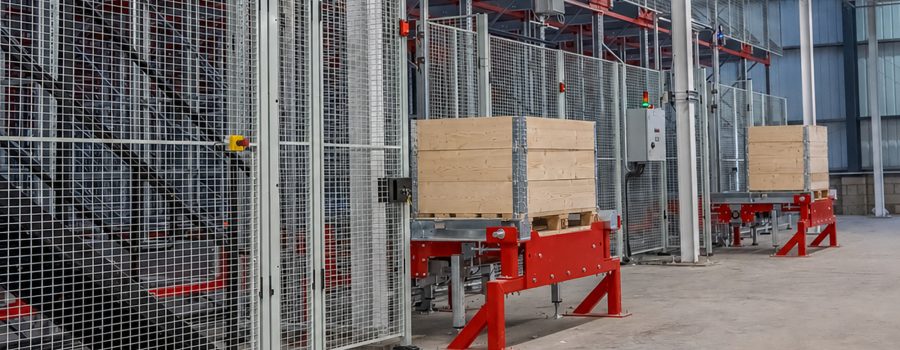
The four key signs that a warehouse needs automation are space pressure, labour pressure, inaccuracy pressure and performance limitations. If your operation is experiencing two or more of these challenges, automated storage systems can often deliver significant improvements in capacity, productivity, accuracy and return on investment.
Many businesses don’t make the decision to automate their warehouse. They reach the point where they can no longer afford not to.
There’s rarely a single moment. It’s usually a slow accumulation: a lease renewal that makes your stomach drop, a peak season that nearly broke the team, a key account you lost because you couldn’t cope with the throughput, or a competitor implements automation and changes the marketplace entirely. One day, you’re managing the situation. The next, the situation is managing you.
Sound familiar?
After nearly 30 years designing and installing dynamic, semi-automated and fully automated storage systems across the UK, we’ve seen this on a regular basis. And while every operation is different, the trigger is almost always one or more of the same four things.
At Thistle Systems, we call them the SLIP triggers – and if two or more of these apply to your facility right now, you’re at or approaching your automation tipping point and you NEED to read on.
S: Space Pressure
Your floor is full. But the problem usually isn’t the building – it’s how the building is being used.
Most warehouses we visit already have racking running six or seven pallets high. The height is being used. What isn’t being used efficiently is the floor itself. In a conventional wide-aisle racking configuration, anywhere from 40% to 55% of your total floor area is aisle space. It has to be, because reach trucks and counterbalance forklifts need room to operate. That means well over half your facility is infrastructure, not storage.
When “capacity” is reached the instinct is to look for more floor space: a new unit on the same estate, a second site, an extension or external storage. Then someone runs the numbers on a 10-year lease and the conversation changes.
Semi-automated and automated storage systems fundamentally change that ratio. By eliminating or dramatically reducing the required aisle widths, they return a significant proportion of that floor area to productive storage. The same building footprint can hold substantially more, not because you’re going higher, but because you’re storing smarter across the space you already occupy.
We recently worked with a food and drink manufacturer in Scotland who was well beyond their capacity and was storing pallets offsite with a 3PL. They were looking at building a new warehouse to accommodate the extra capacity required, however the construction costs were significant and that was before energy costs, rates and the additional labour costs. Instead, we showed them a design featuring a semi-automated storage solution which increase the pallet positions by 100% within their existing four walls. And when we showed them our ROI calculations, the total project cost had a payback period of 1.9 years.
If you’re currently exploring building extensions, new leases, or off-site storage, even just at the research stage, it’s worth pausing to run the comparison first.
L: Labour Pressure
This is the single biggest driver of automation investment right now, and it’s accelerating.
A fully loaded warehouse operative (salary, employer’s National Insurance, holiday, sick pay, recruitment and training) costs somewhere between £28,000 and £34,000 per year. That figure has risen sharply since 2022 and shows no sign of levelling off. Factor in the chronic difficulty of recruiting for physical warehouse roles, the churn rate in the sector, and the productivity loss every time you’re training a new starter, and the true cost climbs higher still.
Now consider what that workforce is actually spending its time doing.
In a conventional racked warehouse, a significant portion of each shift is forklift travel time up and down the aisles, locating pallets, returning to pack or loading onto a wagon. Depending on your layout and SKU count, this can account for 40–50% of an operator’s working day.
Automated storage solutions, where the pallets come to a dedicated collection point rather than the forklift going to the product, eliminate most of that travel time. Throughput per person increases dramatically. In many operations, the same daily throughput volume can be achieved with fewer staff, allowing redeployment to higher-value tasks elsewhere in the business.
If you currently employ eight or more warehouse operatives, the labour maths almost certainly warrants a closer look. It’s not about replacing people. It’s about using them better and not having your performance restricted by a recruitment market that makes that increasingly difficult.
I: Inaccuracy Pressure
Pick errors are more expensive than most businesses realise, because the true cost is almost never tracked in one place.
There’s the direct cost: processing the return, restocking the item, dispatching the replacement. Then there’s the indirect cost: the customer service time, the credit raised, the relationship strain. And then there’s the one that rarely makes it onto a spreadsheet: the cost of the customer who doesn’t complain, just quietly gives the next order to someone else.
Conservative estimates put the average cost of a single mis-pick at between £20 and £50 once you factor all of that in. For an operation processing 500 orders per day at a 0.5% error rate, that’s 2-3 errors per day, somewhere between £15,000 and £35,000 per year, every year, in a cost that feels invisible because it’s scattered across returns, credits and customer service logs.
Automated systems, particularly goods-to-person configurations, routinely achieve accuracy rates of 99.9% or higher. The reduction in mis-picks isn’t a side benefit of automation. For some operations, it’s the single line on the ROI model that makes the decision straightforward.
If your current accuracy sits below 99.5%, or if you don’t have a clear figure at all, this trigger almost certainly applies to you.
P: Performance Ceiling
There comes a point where you’ve optimised everything you can optimise in a manual warehouse, and it’s still not enough.
You’ve reorganised the racking. You’ve adjusted shift patterns. You’ve moved your fastest movers to the perfect zone. You’ve done everything the consultants suggested. And at peak, whether that’s Q4, a promotional period, or a single large new contract, the operation still buckles no matter how much staff you throw at it.
This is the performance ceiling. It’s not a people problem or a process problem. It’s a structural one. Manual operations have a physical throughput limit that cannot be engineered away. Once you’ve hit it, you have two options: accept it as a cap on growth or remove it.
The businesses we work with that are most acutely feeling this trigger tend to be in one of two situations. Either they’re growing faster than their infrastructure can support and they’re turning down contracts or customers they’d otherwise take. Or they’re being asked by a major customer, such as a supermarket, a third-party logistics contract, or a manufacturing partner, to meet capacity, throughput and accuracy commitments they can’t currently guarantee.
All situations have a cost, whether it’s a direct cap on revenue or a risk to your most important relationships.
Automated storage solutions don’t just increase capacity and throughput; they make it consistent and predictable. That predictability is what allows you to make commitments with confidence.
Do Two or More Apply to You?
If you’ve been nodding along at two, three or all four of these triggers, you’re not unusual. Most businesses that come to us have been managing several of them simultaneously for longer than they should, absorbing the additional cost, working around the constraints, waiting for the right moment.
The right moment rarely announces itself. But the triggers do.
The next step doesn’t have to be a major decision. It just has to be an honest conversation about the numbers. We offer a free, no-obligation Automation Feasibility Assessment: looking at your operation, running the actual figures, and giving you a straight answer about whether automation makes sense for you and what the return would look like.
Whether that leads to a project with us or simply gives you clarity, the conversation is worth having.
Book a free Automation Feasibility Assessment
Thistle Systems has been designing and installing storage solutions across the UK since 1996. If you’d like to talk through any of the four triggers in the context of your own operation, we’re happy to have that conversation with no obligation.


