
Most conversations about warehouse automation begin with spreadsheets, payback periods, cost-per-pick calculations, headcount reduction targets. For years, that was the framework: build a business case, prove the ROI, get sign-off.
But something has shifted in the last 12 months. Yes, companies are calling and asking these questions first. But when we start asking questions, the real driver for the project turns to “what happens to our business if we cannot fill our next 10 warehouse positions?”
That is a fundamentally different question. And it means we are having a fundamentally different conversation with clients about automation.
The labour crisis is not a blip
UK warehousing has a structural workforce problem. It is not a temporary tightening of the market that will ease when economic conditions shift. Several forces are compounding at once, and they are not going away.
The core warehouse workforce is ageing. Younger workers are not replacing them at the same rate. Physical, repetitive work in often cold and noisy environments is not attracting the next generation in sufficient numbers. This is not a wage problem that can be solved by raising pay. It is a preference problem, and it is baked into the demographic pipeline.
Post-Brexit, the UK lost a significant portion of its warehouse and logistics workforce when EU free movement ended. Many workers who had formed the operational backbone of large distribution centres simply left and did not return. The pool contracted, and it has not recovered.
Meanwhile, every sector is competing for the same relatively small group of people willing to do shift-based physical work. Amazon, supermarket distribution centres and third-party logistics providers are all chasing the same candidates, pushing wages upward without solving availability. Higher wages do not create workers. They just redistribute the ones that exist.
And then there is turnover. Some warehouses are seeing an annual staff turnover of 40 to 60 percent. The cost of constant recruitment, onboarding and training is substantial, even before accounting for the productivity loss during ramp-up. Managers who should be running operations spend a disproportionate amount of their time managing people out and recruiting people in.
The threat is not automation. It is inaction.
Here is where the traditional automation conversation breaks down.
When labour cost is the primary driver, automation has to win a clear ROI argument against a known wage bill. The maths is straightforward, if sensitive to variables. Capital expenditure in, wage savings out, payback period calculated.
But when availability is the driver, the risk calculation inverts entirely.
You are no longer asking: can we afford to automate? You are asking: can we continue to meet our customer demands without automating?
That is not an efficiency question. It goes beyond budgets and business cases. And it changes what counts as risk. In the traditional framing, the capital expenditure is the risk. In the availability framing, failing to act is the risk. Every month spent waiting is another month of operational vulnerability, agency labour at premium rates and management capacity consumed by recruitment rather than performance.
Boards that would previously have deferred automation decisions because the payback period was borderline are now accelerating them because the alternative is an operation that cannot reliably staff itself.
This is no longer just a ‘big business’ problem
Automation has historically been associated with large businesses. The assumption was that you needed a big warehouse, a substantial throughput volume and a significant capital budget before the numbers worked. That assumption is no longer valid, for two reasons.
First, the technology has changed. Modern automated storage and retrieval systems are modular. They can be configured for smaller footprints, lower throughput requirements and phased investment. A facility handling 3,000 pallet positions can now access the same operational logic as one handling 30,000.
Second, the labour problem does not respect scale. A mid-sized operation cannot absorb 60 percent annual turnover any more comfortably than a large distribution centre. In some ways it hits harder, because there is less management depth to absorb the constant churn.
This is why the automation conversation has moved down-market. Operators who would have dismissed it five years ago are now genuinely asking the question, not because they have suddenly become more ambitious, but because they can no longer afford not to.
The most dangerous position you can take: “we’ve managed so far”
The operators most at risk are not the ones who have struggled to recruit. They are the ones who have coped.
Coping looks like success from the outside. The operation is running. Shifts are being covered. Product is moving. But coping has a hidden cost that rarely appears on a management report.
It can mean that agency labour is essential and costing your business a 30 to 40 per cent premium over permanent headcount rates. Your supervisors are spending one to two days a week on recruitment activity instead of focusing on managing the operations. Productivity targets are being quietly revised downward because the throughput you used to achieve requires consistent people. Training shortcuts are taken because there is never enough time to do it properly before the next intake.
But none of this is being seen as the “cost of not automating.” But it is real, and it is growing – and at some stage its going to become a major issue in your business.
The question worth asking is not whether you have managed so far. It is what your operation actually costs when you add up what the labour crisis is already taking from it.
Automation as continuity, not just efficiency
A well-specified automated storage system does not call in sick. It does not hand in notice two weeks before peak. It does not require induction, retraining or supervision in the same way a rotating workforce does. Its throughput is not dependent on who turned up that morning.
That consistency has a value that does not appear in a cost-per-pick calculation. It shows up in customer service levels, in planning certainty, in the confidence to take on new contracts knowing you can fulfil them
When automation is seen as an efficiency tool, it’s instantly compared against a wage bill. When it is view as a strategic operational continuity tool, it addresses something more fundamental: the ability to run a reliable, predictable operation that meets customer demand – no matter what the labour market is doing.
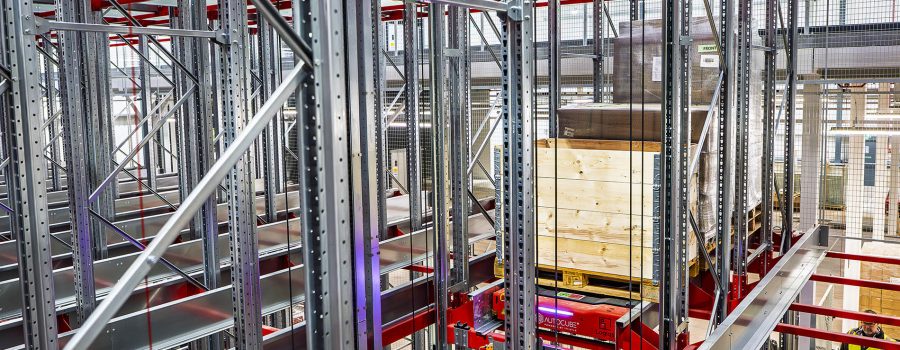
At Thistle Systems, we see this shift clearly in the enquiries we receive. Conversations that used to start with “what is the payback period?” are increasingly starting with “we cannot keep running the way we are running.” The AutoCube system we deploy is configured around the specific throughput, footprint and operational requirements of each site, and the questions that drive the best outcomes are the ones that start with operational reality rather than financial modelling.
The question worth asking in your next leadership meeting
The labour market is not going to fix itself. The demographic trends are established. The workforce contraction is structural. The competition for available workers is intensifying, not easing.
The question worth raising is not: can we afford to automate?
It is: what is our plan if the labour market does not improve?
If you do not have a clear answer to that, it may be time to have a conversation with us. Not about spreadsheets. About what your operation needs to look like in three years, and whether the path you are currently on gets you there.
Contact us now to discuss your operations
Further Reading
- How Much Additional Capacity Will Automated Racking Systems Provide?
- Costs of Automated Warehouse Storage – And Why It’s Worth Every Penny
- ATEX Warehouse Automation. The Complete UK Guide to Safe, High-Density Storage


