Most pallet storage systems were never designed for hazardous environments.
They were adapted. And that’s the problem.
Across ATEX and COMAH regulated warehouses, we regularly see pallet storage systems that:
- Limit storage density
- Rely heavily on forklifts
- Introduce unnecessary risk
- Struggle to meet modern audit requirements
They work.
But they don’t work well enough for today’s hazardous environments.
This is where ATEX automated pallet storage systems change the standard.
This builds on the wider principles explored in our guide to ATEX warehouse automation, which looks at how engineered automation supports safety, compliance, and control across hazardous environments.
What Makes a Pallet Storage System ATEX Compliant?
ATEX environments require systems to operate in potentially explosive atmospheres.
That means that systems must be designed to eliminate ignition sources, control movement predictably, and operate reliably within hazardous zoning.
Traditional pallet racking may meet structural requirements.
But it does nothing to address movement risk, human interaction, or operational inefficiencies.
The Limitations of Traditional Pallet Racking in ATEX Environments
Heavy Reliance on Forklifts
Forklifts remain central to most pallet-based operations. In hazardous environments, this introduces increased ignition risk, greater potential for human error, and unnecessary congestion.
Low Storage Density
Traditional racking systems require aisles, access space, and movement clearance.
The result is significant wasted space and limited use of vertical capacity.
Limited Control and Visibility
Manual systems often rely on operator input and paper-based or disconnected systems.
This creates challenges around traceability, accuracy, and audit readiness, particularly as regulatory scrutiny increases.
The Shift to ATEX Automated Pallet Storage
Automation fundamentally changes how pallets are stored and moved.
Instead of forklifts navigating aisles, movement is handled through system-controlled processes that enable high-density layouts ad significantly reduce human interaction.
Key Benefits of ATEX Automated Pallet Storage Systems
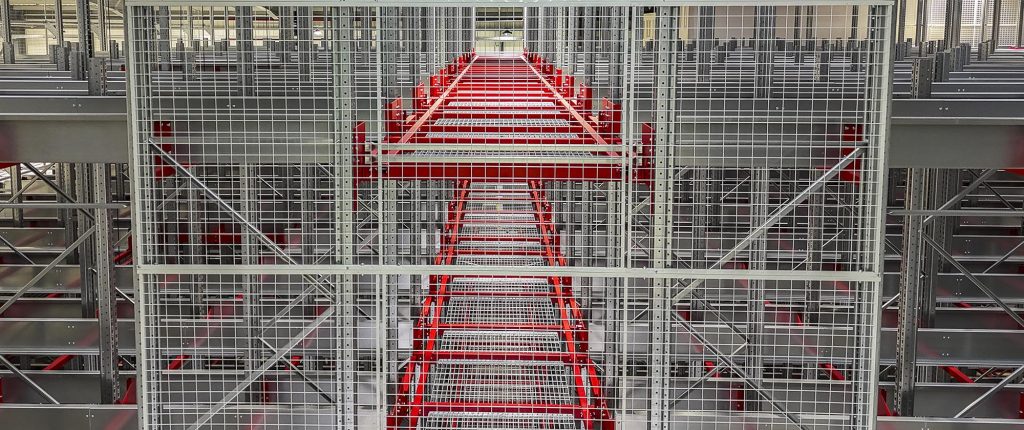
High-Density Storage
Automated systems remove the need for wide aisles, allowing maximum use of cubic space and increased pallet capacity within the same footprint.
Reduced Risk
By removing forklifts from hazardous zones, you significantly reduce ignition risk, human error, and workplace incidents.
Improved Throughput
Automated systems allow parallel movements, faster access to stock, and more predictable operations.
Full Traceability
Every pallet movement is tracked and controlled, proving real-time visibility, audit-ready data, and improved inventory accuracy.
Where ATEX Automated Pallet Storage Delivers the Most Value
These systems are particularly effective where:
- Space is constrained
- Throughput demands are increasing
- Hazardous materials are stored at scale
- Operational risk needs to be reduced
Introducing AutoCube®-X
AutoCube® -X is a high-density, ATEX-rated automated pallet storage system designed specifically for hazardous environments.
It enables:
- Safe, high-density pallet storage
- Removal of forklifts from hazardous areas
- Controlled, system-driven material handling
- Full visibility and traceability
Unlike conventional systems, AutoCube® -X is engineered for ATEX environments from the outset.
Rethinking Pallet Storage in Hazardous Environments
The biggest limitation in most warehouses isn’t space.
It’s the system being used to manage it.
If you’re still relying on traditional pallet racking in a hazardous environment, there is a strong chance you are under-utilising your space, increasing operational risk, and limiting efficiency.
Discover What Your Warehouse Could Achieve
We offer a free warehouse assessment to help you understand:
- Your true pallet storage capacity
- Opportunities to improve safety
- How automation could transform your operation