
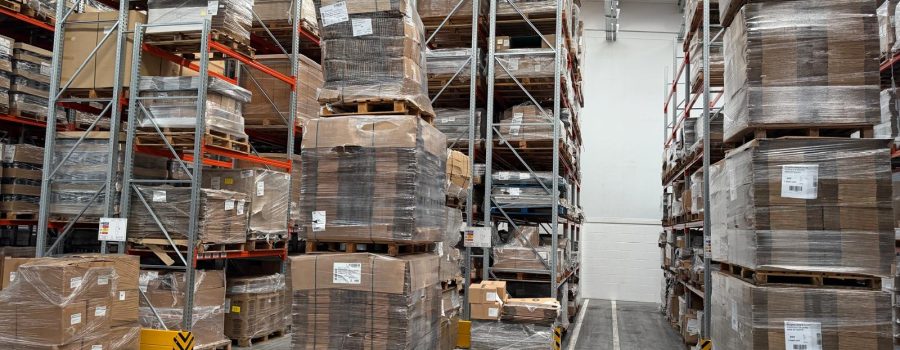
Peak season does more than test warehouse capacity. It reveals the point at which storage, access and movement begin to work against the operation.
For food and drink manufacturers, seasonal pressure rarely arrives as a simple increase in volume. Promotional stock lands early, Christmas and limited-edition ranges compete for accessible locations, production schedules intensify and retailer-specific inventory builds. This can place the warehouse under pressure well before outbound volumes reach their peak.
As internal capacity tightens, stock may need to be relocated, held in temporary areas or transferred to third-party storage. When dispatch volumes later increase, the operation must then manage a more fragmented stockholding model at its busiest point.
The important question is not whether the warehouse coped. It is fully understanding everything the operation had to do to cope, and the true costs incurred.
When Available Capacity Stops Being Usable Capacity
Warehouse capacity is usually expressed as a fixed number of pallet positions. It is a useful starting point, but it does not show how effectively those positions can be used as occupancy rises.
An empty location is not automatically the right location. Batch controls, shelf life, FIFO or FEFO rules, product compatibility, retailer requirements and dispatch priorities all influence where stock can be located and how readily it can be accessed. Seasonal ranges may occupy prime locations for longer than expected, while promotional stock can arrive well ahead of demand.
As the warehouse fills, the team begins to compensate. Pallets are moved to release more suitable positions. Incoming stock is placed wherever room can be found. Temporary floor storage appears. Journeys become longer and retrieval becomes less predictable.
The warehouse may be approaching its practical operating limit before every position is occupied. At this point, accommodating additional stock can require more relocation, longer journeys or the use of third-party storage. This is the point at which available capacity stops being genuinely usable capacity.
Adding more conventional pallet positions does not necessarily solve the problem. If those positions increase travel, reduce accessibility or create more reshuffling, the headline capacity rises while the operation becomes harder to manage.
More Space Does Not Remove Unnecessary Movement
Peak-season inventory is rarely more of exactly the same stock. The product mix changes as well as the volume. Christmas ranges, promotional packaging, retailer-specific products and additional buffers can alter location demand, handling patterns and access requirements.
Ten empty pallet positions therefore do not always provide space for ten incoming pallets. The available locations may be in the wrong zone, difficult to reach or unsuitable for the stock around them. A capacity report can show spare room while the warehouse team struggles to find practical locations.
The result is often more movement throughout the operation.
Fast-moving lines are protected by relocating slower stock. Seasonal inventory passes between reserve storage, temporary holding areas and dispatch marshalling. Forklift travel increases as suitable locations become harder to find.
No single journey appears significant. Repeated across a busy peak, however, these movements consume labour and materials-handling capacity without increasing output. They add traffic to constrained areas, occupy staging space and make product flow less predictable.
This is why successfully surviving a peak is not necessarily the same as managing it efficiently. Orders may leave on time because an experienced team has worked additional hours, brought in equipment or repeatedly reorganised the warehouse. The service result matters, but so does the additional handling and resource needed to achieve it.
While it is useful to measure the volume of cases or pallets dispatched, that doesn’t tell the full story. The number of movements, interventions and temporary workarounds required to achieve that volume provides a clearer picture of how efficiently the warehouse coped. During peak, this may include repeated pallet relocations, increased forklift travel and additional transfers to and from third-party storage.
If Movement Is the Problem, The Storage Model Deserves Attention
When peak inefficiency comes from the way stock is stored and accessed, the next question is whether the storage model should change.
Conventional pallet racking depends on forklifts travelling through aisles to place and retrieve stock. Those aisles are essential to the system, but they occupy a substantial proportion of the building while storing no inventory themselves.
Thistle Systems’ AutoCube® combines high-density automated storage with MAxIQ®, our warehouse orchestration software. AutoCube® provides the physical storage and material-handling system, including the structure, lifts and conveyors, while MAxIQ® provides the intelligence behind the operation, controlling inventory locations, movement priorities, carrier routing and system workflows. Together, they create a single integrated system that can increase storage density, reduce unnecessary forklift travel and improve control over pallet movements throughout the warehouse.
The benefit is not simply storing more pallets within the same footprint. The benefit is being able to handle higher inventory volumes without creating the same increase in travel, congestion and manual intervention that often accompanies peak season.
In a properly designed operation, pallet locations and movements are managed through the control system. Stock can be retrieved when required without operators searching for locations or moving one pallet simply to reach another.
Depending on the system design and integration, retrieval logic can support batch selection, FIFO or FEFO rotation and dispatch priorities, helping the operation maintain greater control as stockholding increases.
That distinction matters during peak season. Higher stockholding should not automatically mean more congestion, more handling and less control.
The Right Solution Depends on the Stock Profile
Automation is not the right answer for every warehouse operation, and it should not be treated as the starting assumption. The storage method must match the SKU profile, its throughput and the constraint the business is trying to solve.
Different product and stock profiles create different storage requirements. Some product families may be well suited to AutoCube®, while others may benefit from dynamic picking towers, semi-automated shuttle racking or other conventional storage methods where accessibility takes priority. In many cases, the most effective approach involves a combination of solutions.
One client benefited from a mixed storage strategy, combining a semi-automated shuttle, pallet live storage, conventional pallet racking and a multi-tier picking tower to dramatically increase capacity, reduce FLT travel, improve picking efficiency and create a smoother operational flow.
The goal is not to automate every pallet. The goal is to apply the right storage method to the right stock.
That problem may be insufficient usable capacity, excessive forklift travel, repeated handling, poor stock access or a growing dependence on overflow storage. The technology has to prove its value against that constraint to deliver a positive ROI, not simply automate because automation is available.
This is why the assessment should begin with the stock and movement profile rather than a preferred product. Pallet dimensions, product families, batch sizes, throughput, stockholding patterns and access requirements all influence the right storage approach.
Peak Review Programme – How to Use Your Next Peak Period to Assess Opportunities
For most food and drink businesses, the immediate priority must be maintaining customer service and keeping product flowing through the operation. So, whilst there may be no opportunity to change the warehouse before the seasonal peak, the period can provide the evidence needed to design a better operation for the next one.
Overall occupancy and dispatch volumes provide useful context, but they do not explain how the warehouse behaves under pressure. A meaningful peak review should look beneath the headline figures and ask:
- At what occupancy level does stock relocations and retrieval times begin to increase?
- Which product families become most difficult to accommodate, and why?
- How many times is a pallet handled before it reaches production or dispatch?
- Where does forklift congestion occur most often?
- How much temporary floor space or third-party storage is required?
- Does additional labour produce a comparable increase in throughput?
- Which batch, shelf-life, rotation or accessibility rules restrict usable capacity most?
- Where are experienced operators compensating for weaknesses in the storage process?
These observations help separate a genuine shortage of physical space from a storage, access and movement problem. They also create a better basis for assessing change.
Instead of beginning with a broad aim to increase capacity or reduce labour, the business can define what a future system must achieve. That may mean increasing usable capacity within the existing footprint, removing repeated pallet movements, maintaining stock rotation more consistently or protecting predictable throughput at higher occupancy.
Any proposed solution, automated, semi-automated or conventional, can then be tested against those requirements.
This makes the investment discussion more specific. Rather than asking whether the business should automate, the team can ask whether a proposed solution will remove the constraint revealed during peak.
Overflow Storage Can Hide the Real Constraint
Third-party storage can provide valuable overflow capacity during a short-term peak. The problem begins when it becomes a routine part of the operating model.
Moving stock elsewhere does not remove the need to receive, identify, transport and retrieve it. It can introduce additional handling stages and make inventory less accessible to production or dispatch. The business gains physical space, but the operation may become more complex.
The same applies to temporary floor storage. It can help the team protect flow during a difficult period, but it may also restrict access, occupy staging areas and make normal movement routes harder to maintain.
These measures can provide valuable short-term flexibility, and during a live peak they may be the most practical options available. The important point is to recognise what they are showing.
If the same reliance on third-party storage returns every year, the issue may no longer be temporary. It may be evidence that the normal storage model does not provide enough usable capacity for the way the business now operates.
Designing for the Next Peak
Peak season will always place additional pressure on food and drink warehouses. The issue is whether that pressure is absorbed by a well-designed operation or managed through another round of temporary fixes.
Better planning and organisation can help, but they cannot resolve a structural mismatch between the building, the storage system and the stock moving through it.
If every seasonal increase leads to more overflow space, more forklift activity and increased labour costs, the operation is sending a clear signal.
This year’s peak should provide the evidence needed to make that decision properly.
The real opportunity is not simply to find enough room for next year’s stock. It is to create an operation in which higher volumes can be handled without causing movement, complexity and operating costs to rise at the same rate.
If every peak produces the same challenges and constraints and the same workarounds, the right answer may not be another overflow warehouse, another forklift or additional staff. It may be a better way of storing and moving inventory.
At Thistle Systems, we begin with the operation rather than the solution.


