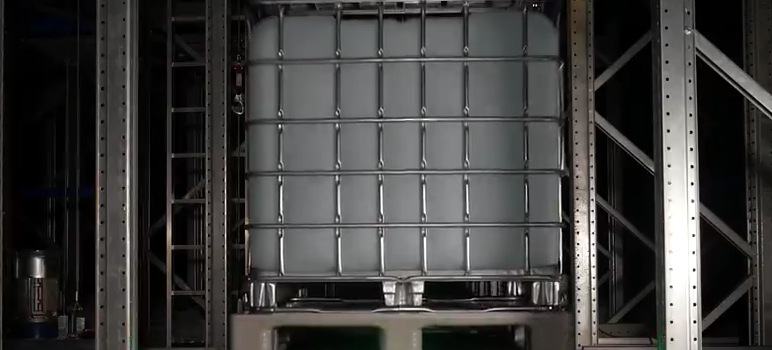
It’s 7:40 on a Tuesday morning and an IBC has just arrived.
The warehouse management system says there are twenty empty positions. The shift lead knows better. One is next to a product that can’t sit beside this one. Two are held for quarantine. Several are at the back of a lane, behind IBCs that would have to be moved to reach them. The rest are the wrong size, the wrong rating or the wrong side of a segregation line.
Twenty empty positions, and not one of them can take the IBC.
So the forklift driver does what warehouse teams do every day. They move an IBC to make room for another, to make room for the delivery. By the time the incoming IBC is put away, three others have been moved simply to create a suitable space. Meanwhile, another delivery is waiting to be unloaded and an IBC needed for production is still waiting to be picked.
One put-away has become four handling tasks. Only one has completed the work the operation actually needed.
If that sounds familiar, the issue may be more than a shortage of space. It may be what that shortage of suitable space is costing your operation every day.
Physical Capacity versus usable capacity in a Chemical Warehouse
Physical capacity tells you how many storage positions are in the building. Usable capacity tells you which of those positions can accept the product you need to store, under the conditions required.
In a chemical warehouse, that distinction matters. Product compatibility, segregation requirements, quarantine status, dimensions and weight can all restrict where an IBC can go. Even a suitable position may take time and additional handling to access.
An overall occupancy figure hides those differences. A warehouse can have empty positions and still struggle to receive deliveries, replenish production or prepare orders on time. The commercial question is therefore bigger than “How many more IBCs can we fit?”
How much work does it take to store and retrieve them, and what does that leave the operation able to deliver?
The Additional Hidden Cost That Also Has To Be Considered
The immediate costs of additional handling are familiar: driver time, forklift use and energy.
But while a driver is moving IBCs out of the way and putting them back, they cannot unload the next vehicle, replenish production or complete another pick. That lost availability matters. The business is paying for the additional movements while other work competes for the remaining time.
Depending on where the pressure falls, the consequences can include:
- Slower goods-in, with vehicles waiting longer and incoming IBCs occupying receiving areas.
- Less reliable production supply, as planned replenishment competes with urgent relocations.
- Longer order preparation times, making dispatch deadlines harder to meet.
- More congestion, as temporarily positioned IBCs take up working space.
- Additional labour/overtime, where the team needs longer to complete the planned workload.
- More supervisor intervention, with time spent finding suitable positions, changing priorities and resolving delays.
A single relocation may have little impact. Repeated across products, shifts and working weeks, the same pattern can consume a significant share of the warehouse’s resources.
Your team may be keeping everything moving. That does not mean the storage arrangement is allowing them to work efficiently.
Why Experienced Chemical Warehouse Teams Mask Hidden Costs
Experienced warehouse teams get good at managing storage restrictions.
They know which lanes are difficult, which products need space kept aside and which deliveries are likely to trigger a reshuffle. They find ways to get the work done. That knowledge is valuable, but it can also make the underlying cost less visible.
Double handling becomes part of the expected put-away time. Difficult retrievals are built into the picking schedule. Staying late to clear a backlog becomes an accepted response to a busy day. Over time, the business may start to treat those demands as the normal cost of running the warehouse.
This is why counting completed movements alone can be misleading. A forklift making more movements may be supporting higher throughput. It may also be moving the same IBCs repeatedly. The useful distinction is between the required movement, which completes a receipt, replenishment or dispatch task, and additional handling, which makes that movement possible.
Both occupy the team. Only one progresses the task the business needs completed.
Where AutoCube®-X and MAxIQ® fit
Where repeated relocations and restricted access are limiting performance, changing how storage works may achieve more than continuing to rearrange it.
AutoCube®-X provides automated storage and retrieval for palletised goods, including IBCs and drums, and its uniquely ATEX certification makes it suitable for hazardous-area applications assessed against the specific site and product requirements.
By automating storage and retrieval, it can reduce routine forklift activity within the storage area and support more controlled handling.
MAxIQ® supports the information and control side of the operation, providing visibility of stock locations and movements. Physical storage and the information used to manage it need to work together if the warehouse is to operate reliably.
The potential value extends beyond fitting more IBCs into the building. Depending on the application, it can include:
- Reducing manual relocations and the forklift time they consume.
- Making retrieval times more predictable.
- Improving the flow of IBCs through receiving and dispatch.
- Supporting inventory visibility and traceability.
- Accommodating additional volume within the available space and operating hours.
Those benefits need to be tested against the actual operation. Any internal repositioning required by an automated system must also be accounted for when assessing throughput. Moving work from a forklift to automation does not make that work disappear.
Receiving areas, transfer points and dispatch must also be able to support the required flow. Improving storage performance will have limited value if the next stage cannot keep pace.
That is why the assessment needs to consider the product mix, stock profile, peak movements and production requirements alongside the chemical storage constraints.
Chemical risk assessments, appropriate segregation and safe operating procedures remain essential, whatever storage approach is selected.
Compare the cost of delivering the operation
Comparing the investment cost of automated storage with the purchase price of conventional racking tells you only part of the story.
The more useful comparison is what each approach costs to deliver the capacity, throughput and service the business needs. That means considering the people, equipment, space and working hours required, alongside maintenance, energy, software and support.
It also means understanding the operational consequences of double and triple handling. How much additional labour does it absorb? Does it contribute to overtime? Does it restrict throughput or bring forward the need for external storage?
Some improvements may create direct savings. Others may release capacity within the existing team, improve service reliability or defer future expenditure. Those outcomes should be distinguished clearly so the business case reflects what can actually be achieved.
Conventional storage may still be the right answer. A combination of approaches may work best for different product groups. The decision should follow the operational evidence, with both options assessed against the same requirements.
Back to that Tuesday morning
The IBC does get put away eventually.
But the cost of that morning was more than three additional movements. It included the work the driver could not do while making space, the delay passed to the next task and the supervisor’s time spent keeping everything on track.
The occupancy report still showed twenty empty positions. It said nothing about the effort needed to use them.
The hidden cost of capacity is in every extra movement needed to make the space work, and every productive task that has to wait.
If double and triple handling are becoming part of the daily routine, it may be time to look beyond the pallet count.