
If you’re weighing up warehouse automation, the first questions are almost always about the hardware. How fast are the shuttles. How many pallets will it hold. How quickly do the carriers charge. How many lifts you need, and what throughput the whole thing will hit.
Those questions matter, and the answers set a real limit. The quality and reliability of the physical automation defines the ceiling on what a system can do. What the warehouse actually achieves under that ceiling depends heavily on the software that runs it. Once the equipment is installed, the software behind it decides what moves, when, where it goes and which machine handles it, and that has a large bearing on the performance you get for the money.
What warehouse orchestration software actually does
Warehouse orchestration software coordinates every movement inside an automated store. It decides what needs to move, in what sequence, and which shuttle, lift or conveyor should handle it, so the system responds to real operational demand rather than working through tasks in a fixed order.
Picture what’s happening inside a busy automated pallet warehouse on any given morning. Orders are arriving, pallets are being received and put away, other stock is being retrieved, production may be asking for materials, and dispatch may have a deadline that’s just jumped up the queue. Several shuttles, lifts and conveyors are free at different moments. Something has to decide the order of work and route each job to the right piece of equipment. That decision-making is orchestration, and it’s the layer that sits between your operating priorities and the machines on the floor.
Two sites can run near-identical hardware and still need very different rules. One is driven by keeping a production line fed. Another lives or dies by dispatch cut-offs. A third has to hold tight batch, segregation or FIFO control because of what it stores. The equipment is the same in each case. The rules that govern it are not, and those rules are where a lot of the real-world performance is won or lost.
Start with the data, not the shuttle count
Before we specify how many shuttles, lifts or conveyors a warehouse needs, we want to understand the operation it has to serve. How many SKUs are stored, how often they move, what a normal day looks like next to a peak day, where the bottlenecks sit today, and how all of that is likely to shift over the next 5 to 10 years.
Those answers shape the physical design. They should shape the software configuration just as directly, because the rules MAxIQ®, our control and management system for AutoCube®, follows are only as good as the understanding of the operation they’re built on. We’ve written before about why understanding your warehouse data comes first, and it remains one of our core beliefs on any project.
Why orchestration decides real performance
A shuttle can move quickly and still add little if it spends time waiting for its next instruction. A warehouse can have several lifts and see poor combined output because work is shared badly between them. A storage system can offer excellent density and then generate needless movements every time stock is called for, simply because of where that stock was put away.
In each case the hardware is capable. The orchestration is what turns that capability into throughput. This is why judging automation on headline hardware figures alone can mislead. What you’re paying for is the performance of the complete system, and that comes from hardware, software and the data underneath both.
Reliability comes from hardware and software together
Reliability is usually near the top of the worry list, and the first question is what happens when something breaks. Sound mechanical engineering, sensible redundancy and good maintenance are essential to the answer. So is the software.
When several routes or machines are available, the control system needs to use them well. If one part of the system goes down for maintenance, can the work be redistributed. Can priorities change without stalling the wider operation. Resilience comes from the hardware and the software being designed to work together, not from either on its own.
The warehouse should keep learning after go-live
An automated warehouse produces a detailed, continuous record of how it’s performing: throughput, equipment utilisation, stock movements, peaks, waiting times, exceptions, and changes in how individual SKUs behave. The value isn’t in seeing that on a screen. It’s in acting on it.
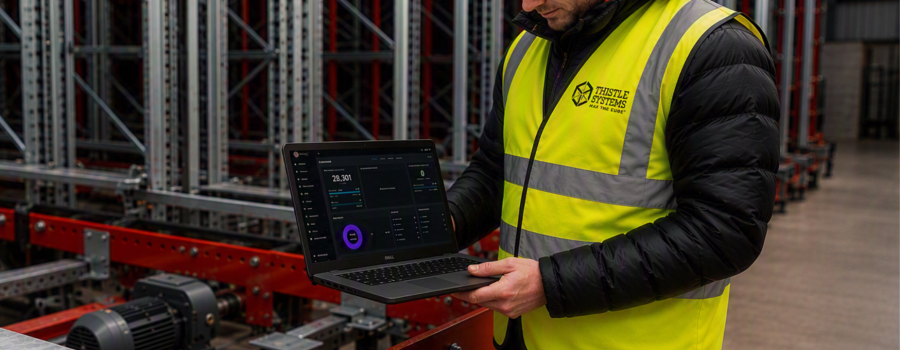
MAxIQ® 2.0 makes that practical. Its operational performance analysis reports both the mean and the median duration for jobs and tasks, breaks them down by operation type (inbound, outbound, staging, picking and stock take), and plots individual durations over time, so a supervisor can see when the slow ones happened and whether a change made a difference afterwards. A live 3D view of the store and detailed equipment monitoring sit alongside it. The point of all this is a warehouse that can be reviewed and improved over the years after commissioning, rather than one left unchanged from the day it goes live. For an operations director, that’s a materially different proposition.
Why we built MAxIQ® in-house
We developed MAxIQ® ourselves, with our own software engineers working next to the engineers who design and deliver the automation. Operators don’t really want another piece of software. They want the warehouse to perform. Owning the software gives us direct control over how the hardware, the operating rules and the data come together, and it means we can keep developing how a system behaves as the customer’s operation changes.
And operations do change. Ranges, volumes, customers, production requirements and service expectations all move over the life of an installation, and the software controlling a major investment has to move with them. If a change is needed in 3 years’ time, it matters who’s responsible for making it.
Our AutoCube® system uses sixth-generation four-way shuttle technology from Logiqs, who pioneered it and have refined it across installations worldwide. We rate that hardware highly. Pairing it with software we own and develop ourselves is what protects the performance of the investment over time.
The questions worth asking about the software, early
The practical advice is to bring the software into the conversation before the hardware is chosen, not after. Worth asking any automation supplier:
- Who develops and controls the software, and who fixes or extends it later.
- How your warehouse data will be used to decide how the system operates.
- Whether the operating rules can be adapted around your business.
- How it integrates with your ERP, WMS or production systems.
- How it manages priorities, exceptions and equipment availability.
- What information your operations team will get once the system is running.
- Whether the software can keep evolving as your operation changes.
These carry as much weight as shuttle speed, battery performance or a theoretical throughput figure.
Hardware, software and data are one system
The hardware defines what an automated warehouse is capable of doing. The orchestration software has a large say in how much of that capability you actually use. The data tells you what the operation needs from both. Get the three working together and automation does more than move pallets without people: it gives you better capacity, better control and a clearer basis for the decisions you make about the operation.
So spend time on the shuttles, lifts, conveyors and racking. Spend as much time understanding the software that will sit behind them, and the data that should shape it. Over the life of the investment, that side of the system often has more influence on performance than the specification sheet suggests. If you’re scoping a project and want to look at the software as seriously as the steelwork, that’s a conversation we’re always happy to have.
Frequently asked questions
What is warehouse orchestration software?
It’s the software that coordinates movement inside an automated warehouse, deciding what moves next, in what order, and which shuttle, lift or conveyor handles it. It turns the operation’s priorities into instructions for the equipment in real time.
Is warehouse orchestration software the same as a WMS?
No. A warehouse management system manages inventory and warehouse processes broadly, across whatever storage and equipment you run. Orchestration software sits closer to the automation itself, deciding in real time how each movement is carried out. MAxIQ®, our control and management system for AutoCube, performs that orchestration role and integrates with your existing WMS or ERP rather than replacing it.
Why does the software matter as much as the hardware in warehouse automation?
The hardware sets the ceiling on what a system can do. The software determines how much of that ceiling you reach, by deciding where stock is stored, how work is sequenced, and how equipment is used when several machines are free at once. Good hardware run by poor decision-making underperforms.
What should I ask about the software before choosing an automation supplier?
Ask who develops and controls it, how your data will shape the operating rules, whether those rules can adapt to your business, how it integrates with your ERP and WMS, and whether it can keep evolving as your operation changes.


