Drum storage is one of the most underestimated risks in hazardous warehousing – and one of the most overlooked opportunities for improvement.
In many facilities across the UK, drums are still managed using the same processes that have been in place for decades: forklifts moving continuously through hazardous zones, storage layouts built around access rather than density, and inventory managed through manual checks that are difficult to audit and easy to get wrong.
When we carry out warehouse assessments, we see the same pattern repeatedly – congested storage areas, limited traceability, poor use of vertical space, and a level of forklift activity that would concern any health and safety professional. The assumption is usually the same:
“That’s just how drum storage works.”
It doesn’t have to.
The Real Cost of Traditional Drum Storage
The challenges with conventional drum storage go beyond inconvenience. In environments storing hazardous liquids, flammable substances or chemicals subject to DSEAR (Dangerous Substances and Explosive Atmospheres Regulations), the risks are operational, regulatory and financial.
Safety exposure is significant. Forklifts operating in hazardous zones introduce ignition risk, collision risk and the constant possibility of a spill. The more forklift movements a facility requires, the greater the cumulative risk. In drum storage, the volume of movement is typically high.
Storage efficiency is poor. Traditional drum storage layouts require wide aisles, large manoeuvring areas and access gaps between rows. This is understandable when forklifts need to operate freely, but it means a significant proportion of your available cubic space is permanently wasted. Most facilities we assess are using far less of their storage volume than they could be.
Manual handling creates compliance risk. Inventory accuracy, product rotation and traceability are difficult to guarantee when processes rely on people. As DSEAR and wider hazardous material storage regulations continue to evolve, the ability to demonstrate precise control over what is stored, where it is stored, and how it has been handled is increasingly critical during audits.
How Automation Changes Drum Storage Completely
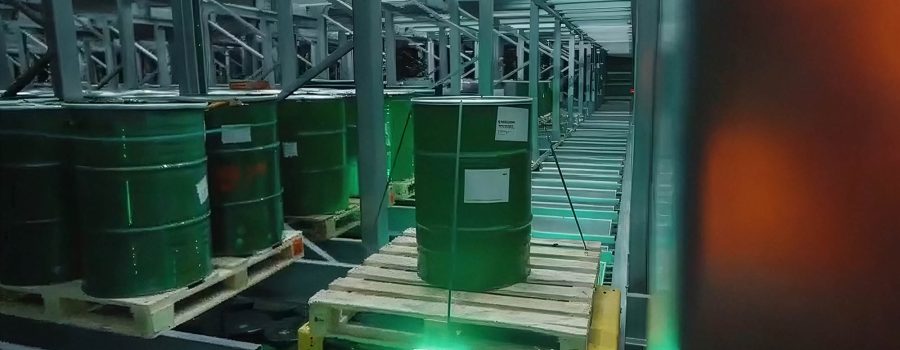
Automated drum storage systems replace unpredictable manual movement with controlled, system-led operation. Rather than forklifts continuously navigating hazardous zones, the system manages storage, retrieval and product movement with precision, reducing human interaction with hazardous materials to a minimum.
The operational shift is substantial:
- Safety improves immediately. Fewer forklifts in hazardous zones means lower collision risk, lower ignition risk and lower spill potential. In DSEAR-regulated environments, this reduction in ignition sources is directly relevant to compliance.
- Storage density increases significantly. Automated systems work vertically and require far narrower aisle configurations than forklift-based operations. Facilities that adopt automation routinely find they can store considerably more product within the same footprint, delaying or eliminating the need for expansion.
- Traceability becomes reliable. Every drum movement is tracked in real time. Inventory data is accurate, rotation is system-enforced, and audit records are generated automatically rather than compiled retrospectively.
- Operations become more predictable. Retrieval consistency, throughput and product flow all improve when the system, not individual operators, is controlling movement.
Introducing AutoCube®-X for Hazardous Drum Storage
AutoCube®-X is Thistle Systems’ automated drum storage solution, engineered specifically for hazardous warehouse environments where safety, density and compliance cannot be compromised.
Unlike general-purpose automation applied to a hazardous setting, AutoCube®-X is purpose-built for this environment. It is designed to operate safely with hazardous liquids and flammable materials, delivering high-density automated storage with full system control from the moment a drum enters the facility.
What AutoCube®-X delivers:
- Controlled, automated movement of hazardous drums, eliminating the need for forklifts in the storage zone
- High-density storage configurations that maximise your available cubic space
- Full real-time traceability and inventory visibility
- Reliable FIFO or FEFO rotation, enforced automatically
- Audit-ready data and reporting at all times
AutoCube®-X is part of Thistle Systems’ wider Max the Cube® approach, a philosophy built around unlocking the cubic potential within your existing facility before committing to expansion. For hazardous drum storage, where space constraints and safety requirements collide, this approach consistently delivers measurable results.
Where Automated Drum Storage Delivers the Most Value
Automation provides the greatest return in environments where:
- Large volumes of hazardous liquids or chemicals are stored in drums
- Space is constrained and expansion is costly or not feasible
- DSEAR compliance and audit readiness are ongoing operational concerns
- Current forklift activity in hazardous zones represents an unacceptable risk level
- Inventory accuracy and traceability are under increasing scrutiny
If your facility meets any of these criteria, it is worth understanding what a more efficient storage design could look like.
The Biggest Issue Is Rarely a Lack of Space
In most hazardous warehouses, the constraint isn’t the building: it is the layout. Inefficient storage design, built around the limitations of forklift access, leaves significant cubic capacity permanently unused.
With the right automation strategy, it is possible to increase storage density, improve safety, reduce operational risk and gain full control over your hazardous drum inventory, all within the facility you already have.
Find Out What Your Warehouse Could Achieve
We offer a free initial warehouse assessment to help you understand your current storage limitations, quantify the opportunity for improvement, and explore how automated drum storage could transform your operation.
Most clients are surprised by how much additional capacity is available within their existing footprint.
Frequently Asked Questions
What regulations apply to drum storage of hazardous materials in the UK? Hazardous drum storage in the UK is primarily governed by DSEAR (Dangerous Substances and Explosive Atmospheres Regulations 2002), alongside COSHH (Control of Substances Hazardous to Health) and relevant fire safety legislation. These regulations require operators to assess ignition risks, control exposure, and maintain accurate records of hazardous substances on site. Automated drum storage systems can directly support compliance by reducing ignition sources, enforcing safe handling procedures and maintaining real-time inventory records.
How does automated drum storage reduce ignition risk in DSEAR-regulated environments? A key source of ignition risk in hazardous warehouses is forklift activity, including the combination of mechanical operation, heat generation and potential for impact near flammable or explosive substances. By replacing continuous forklift operation with controlled automated movement, systems like AutoCube®-X significantly reduce the number of ignition sources within the storage zone.
Can automated drum storage systems increase capacity within an existing building? Yes, this is one of the most significant benefits. Conventional drum storage requires wide aisles and large manoeuvring zones for forklift access. Automated systems work vertically and require far less aisle space, which typically allows a substantially higher number of drums to be stored within the same building footprint.
What is AutoCube®-X and how does it differ from standard automated storage systems? AutoCube®-X is Thistle Systems’ automated storage solution designed specifically for hazardous warehouse environments. Unlike general warehouse automation systems, AutoCube®-X is engineered to handle drums containing hazardous liquids and flammable materials safely, with system-controlled movement, full traceability and configurations that meet the requirements of DSEAR-regulated facilities.
How do I find out if automated drum storage is right for my facility? Thistle Systems offers a free initial warehouse assessment to help you evaluate your current storage design and understand the potential for improvement. To arrange an assessment, contact our team here.