
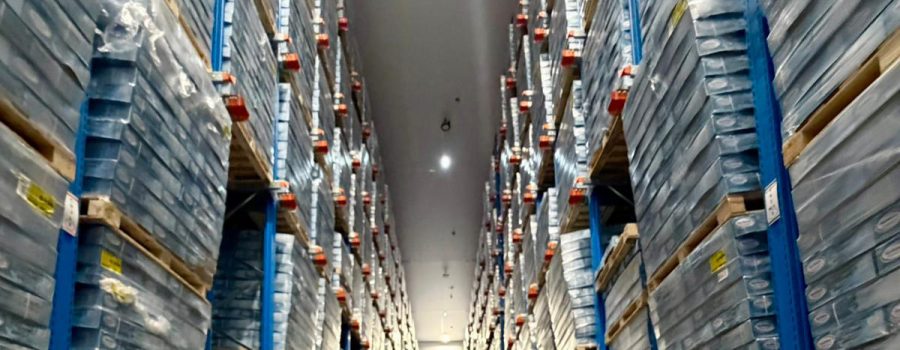
Cold storage is the most expensive warehouse space there is. Refrigeration alone can account for the majority of a facility’s electricity use, and every cubic metre you build has to be chilled and held at temperature around the clock, whether it’s holding product or not.
That single fact changes how you should think about racking. In an ambient warehouse, the storage decision is mostly about capital cost and floor space. In a cold store, it’s an operating-cost decision that will shape your energy bill for the life of the building. Choosing the wrong system doesn’t just cost you once. It costs you every day the plant is running.
Which is why drive-in racking is such a common choice for chilled and frozen storage, and also why it’s so often misunderstood.
Why drive-in racking is the instinctive choice
For the right operation, drive-in racking is an excellent use of cold space, and it earns its popularity honestly.
It’s a high-density system. Forklifts drive directly into deep lanes to place and retrieve pallets, which removes most of the aisles that conventional selective racking needs. Fewer aisles means more pallet positions in the same footprint, and in a cold store it also means less refrigerated air volume doing nothing. Independent industry figures put drive-in at up to 75% more pallet positions than selective racking in the same space.
The commercial logic follows naturally. More positions in the same building gives you a low capital cost per pallet position, and a denser block of product means you’re cooling less empty space. For an operation with a small number of product lines, high volume per line and steady, predictable movement, drive-in is frequently the right call. When the stock genuinely suits it, few systems compete on cost.
None of that is in dispute. The problem starts when the number on the drawing gets treated as the number you’ll actually live with.
The gap between cost on paper and cost in use
Here’s how cost per pallet is usually calculated: take the price of the racking, divide it by the number of positions on the design drawing, and compare the result against other systems. Lowest number wins.
It’s a clean calculation, and it’s often misleading, because it quietly assumes every position on the drawing is usable all of the time. In practice, a storage system only delivers its paper cost per pallet if you can genuinely fill and empty every position it contains. The moment a meaningful share of those positions sit unusable, the real cost per pallet you’re paying rises, sometimes sharply, while the drawing still shows the same tidy figure.
In a cold store, that gap between theoretical and real cost is more expensive than anywhere else, because an unusable position isn’t just wasted capital. It’s refrigerated capital, chilled to temperature continuously while earning nothing.
Honeycombing: the hidden cost in deep-lane storage
The main reason drive-in positions go unusable is honeycombing.
Drive-in lanes are single-SKU by design. Every position in a lane, front to back and top to bottom, has to hold the same product, because you can’t reach a pallet at the back without first removing everything in front of it. That’s fine when a lane empties and refills cleanly. It becomes a problem when lanes sit part-used.
Picture a lane ten pallets deep with three pallets left in it. Those three positions are occupied. The other seven are empty. But you can’t use those seven empty positions for a different product without mixing SKUs in the lane, so they sit there, empty and unavailable, until the lane clears completely. Multiply that across dozens of part-used lanes and the effect compounds fast. Your building looks full. Your utilisation tells a very different story.
The wider and more variable your SKU range, the worse honeycombing gets, because you have more part-used lanes at any given moment. A store designed for a handful of high-volume lines can run beautifully. The same racking asked to hold a broad, mixed, unpredictable range will honeycomb heavily, and every honeycombed position in a freezer is being chilled to minus 25 while contributing nothing to capacity.
Industry rules of thumb suggest keeping utilisation above roughly 75% to keep deep-lane economics intact. Below that, the cost per pallet you’re genuinely paying drifts a long way from the cost per pallet on the drawing.
Density is not the same as utilisation
This is the distinction the whole decision turns on, and it’s worth stating plainly.
Density is how much you can physically fit into the space. It’s the number on the drawing, the headline figure, the 75% more positions.
Utilisation is how much of that you can actually use at any given moment, once your real SKU range and stock movements are taken into account.
Two cold stores can have an identical pallet count on paper and completely different running costs, because one runs at 90% utilisation and the other, honeycombing badly, struggles past 60%. In a freezer, where you pay to refrigerate the whole cube regardless, utilisation is the number that decides your cost per pallet, not density. A system that stores slightly fewer pallets but keeps almost all of them usable can be far cheaper to run than a denser one that locks a third of its positions away.
Density gets you the impressive figure. Utilisation pays the bills.
The alternatives, and when each one fits
Drive-in is one option among several, and the honest answer is that none of them is universally best. Each recovers a different amount of usable cold volume for a different stock profile.
- Selective (adjustable) pallet racking gives 100% direct access to every pallet and suits a wide SKU range with lots of individual picks, but it needs the most aisles, which in a cold store means the most refrigerated air to store the fewest pallets.
- Drive-in racking gives high density and low cost per position for a few high-volume lines with steady movement, at the cost of selectivity and a real honeycombing risk if the profile doesn’t fit.
- Push-back racking offers good density with better selectivity than drive-in, holding several SKUs across lanes on inclined carts, suiting medium ranges and mixed throughput.
- Mobile racking mounts selective racking on powered bases that close up the aisles until one is needed, recovering a large amount of floor space while keeping full selectivity, which can suit slower-moving cold stock where access still matters.
- Pallet shuttle and full automation use a shuttle travelling inside the rack rather than a forklift, so the wide drive-in aisles largely disappear and honeycombing is actively managed by the control system, suiting high-throughput operations that need both density and usable access.
There’s no ranking here that holds true across every site. The best system for a low-SKU, high-volume frozen operation is often the wrong system for a chilled store with a broad range and constant picking.
How to actually decide
If cost per pallet on the drawing can’t be trusted on its own, what should the decision rest on?
The answer is your own data, gathered before any system is chosen. Three things matter most:
- The number of SKUs you’re storing. A narrow range points one way, a broad and growing range points another.
- The complexity of throughput for each line. Steady, predictable movement suits deep-lane density; variable or unpredictable movement raises the honeycombing risk.
- Your movement and rotation patterns. FIFO or LIFO requirements, seasonal peaks and how often lanes clean out completely all change which system genuinely performs.
Model those against each option and the real cost per pallet, the one you’ll actually pay to run, comes into focus. Very often the answer isn’t a single system at all, but a combination: deep-lane density for the fast, high-volume lines, and a more selective method for the long tail of mixed stock. Get the analysis right and the system tends to choose itself.
At Thistle Systems, this is where we start every cold store project: with the SKU profile, the throughput and the movement data, before we recommend anything. Sometimes that leads to drive-in racking, and we install it with confidence when the stock suits it. Sometimes it leads somewhere else entirely. What matters is that the decision is made on how your operation actually behaves, not on whichever number looks lowest on the drawing.
Frequently asked questions
Is drive-in racking good for cold storage? It can be an excellent fit for cold storage when the operation has a small number of product lines, high volume per line and steady, predictable movement. Its high density reduces the refrigerated air volume and gives a low capital cost per pallet position. It’s a poorer fit for a wide or variable SKU range, where honeycombing leaves positions unusable.
What is honeycombing in drive-in racking? Honeycombing is when positions in a storage lane are empty but unusable, because the lane is single-SKU and can’t take a different product until it clears completely. A part-used lane ties up its empty positions. In a cold store those empty positions are still being refrigerated, so honeycombing directly raises your cost per pallet.
Why is cost per pallet misleading in cold storage? Cost per pallet is usually calculated as rack price divided by the positions on the drawing. That only holds if every position is usable all the time. Once honeycombing or a poor stock-to-system fit takes positions out of use, the real cost per pallet rises while the paper figure stays the same. In a freezer, unusable positions are also being chilled, compounding the cost.
What’s the difference between density and utilisation? Density is how many pallets you can physically fit in the space. Utilisation is how many of those positions you can actually use at any moment, given your real SKU range and stock movements. In cold storage, utilisation drives your true running cost far more than density does.
Which cold store racking system is cheapest to run? There’s no single cheapest system. Drive-in, push-back, mobile, shuttle and automation each deliver a different amount of usable cold volume for a different stock profile. The cheapest to run is the one whose usable utilisation best matches your SKU count and throughput, which is why the decision should start with your operational data rather than headline cost per position.
Thinking about a new cold store, or getting more out of the one you already run? Thistle Systems designs high-density and automated storage around how your stock actually moves. Get in touch for a conversation about your operation.


